Cover Cool
Where the money came from I can’t recall. But eventually I had enough. Down to the drug store on the corner I went, to make the first purchase of this kind, ever.
I seemed to know which one I was going to buy, never having bought a record before. A bit shy, I stepped up to the cashier and laid down around five dollars for the first lp of my life: Dylan’s Highway 61 Revisited. The cashier looked at me as though I knew some secret something. I was eleven, and I’d crossed over, into the land of cool, the land of secret signs, of the shape of things to come.
*
Everybody who was around during what became the Sixties knew that the sound of the record is one thing. But the look.
Man, the look of the cover was a world. The cover is what you did while you were listening. Your mind poured over it. It was the cover you parsed, and pondered, and passed back and forth. The cover had its own literacy and poetics, its own ways. The cover was a badge, a secret membership, a pledge you made to the fellowship of the mystery days. And the cover was acerage. It was illiad and odyssey. It was a weather system, a parchment, a kind of holy book. We all lost something when the cassette came on, and then the cd, and spotify and the rest. Some kind of a library went out of style, out of business, out of sight, expendable, like shrink wrap.
*
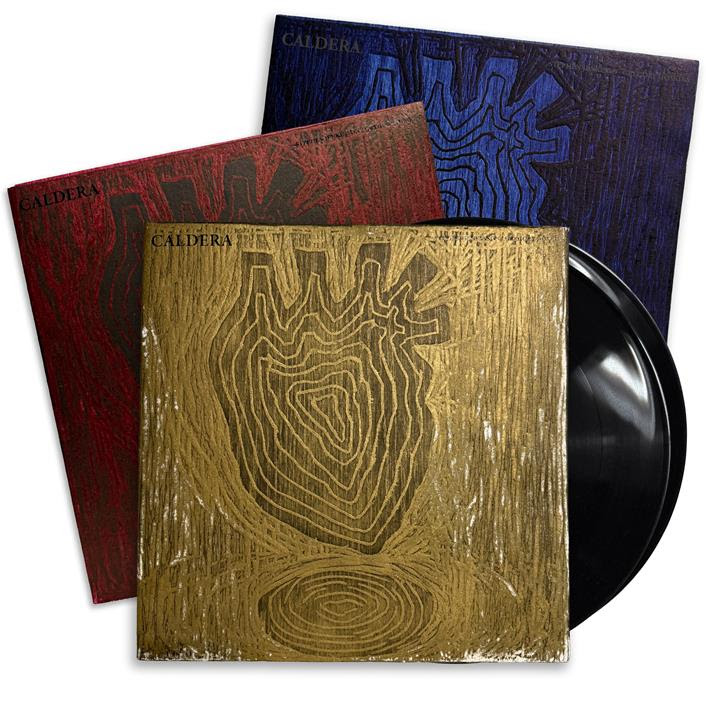
When the making of Caldera really began to spit and spark, the idea of doing a vinyl version came with it. I – this is so me – thought it was pompous and overblown, and nobody’d want one. I figured all the turntables were gone. But Hoskins and Adam Bowman schooled me otherwise: there were aficionados of the lp even still. Even before we knew what the record was going to be called, we were onto the graphic design. We hooked up with Nico Cruz-Bolañas, a young artist in Oaxaca, grabado-central in the art world. We were after something that sounded good, looked good and felt good in the hand. Before we knew what the record was called, we knew we were going to make the record jacket from scratch. We had a few good talks with Nico, though we couldn’t really tell if he got what we were on about. He went off, and maybe two weeks later we had the name, and the look, and the feel of Caldera.
*
In February, in a redolent print studio hidden behind adobe walls in central Oaxaca, Nico and Nathalie and I hovered over the possibilities.
We had ‘volcanic’. We had ‘seismic’. We had the volatility and alchemy of the forge. We had the fine magic of the caldron in the kitchen. We had three hundred sheets of fine cotton paper, plywood plates for carving, and we had the idea that human love is at least as ramshackling as whatever made the continents and the seas between them. Through young Nico’s inspired translation of our musical and poetic ideas, we emerged with the ‘heart is a continent’ icon, with topography and ripples. For the centrefold we have the ‘cardiograph is a seismograph’ icon. Both are remarkably faithful in image and spirit to the music they sheathe.
The intense downward force of the printing press turned the damp paper into something molten and malleable and three dimensional. When it dried and cooled, it was a gorgeous furrowed record of inspiration and art making. The three colour combinations we found soon had me swooning, and we were sending photos and reels to Gregory back in Canada to check on whether this was really as great as I thought it was. It is.
The cover for Caldera defines everything of merit in the term ‘handmade’.
Caldera: The barely cooled mouth of a volatile primeval force of nature
Caldera: The two disc vinyl release of the new Nights of Grief and Mystery record.
Stephen Jenkinson
Founder of Orphan Wisdom

When Stephen was making his way through Harvard in the early 70’s, I was making my way to the basement of my parents’ house where I’d fashioned a recording studio: two cassette decks, a Traynor M6400 mixer, and a no-name mic hanging by its own cord from the ceiling rafters. It’s where, at 12 years old, I heard my recorded singing voice for the first time and—though I can’t exactly recall—must’ve been where I first wondered if I’d ever get to make a proper record. I did. Eventually. Sort of.
The music recording world can be divided into two camps: digital and analog. It’s zeros and ones on hard drives VS a needle reading etched valleys on vinyl. By the time I started my recording career, the digital forces had flooded the analog valley. We recorded on digital tape and then computers instead of magnetic tape. We made CD’s instead of records. That format shift began to change how recorded music was delivered to us, and how we received it. It’s not an overgeneralization to say that modern listening habits relegate music to the background, fading it into the paint on the walls of our shops, offices, and homes. A stream for the unconscious, if you will.
The word ‘analog’ has buried in its’ Greek roots “proportionate” or “according to due proportion.” This, it turns out, is likely why Caldera is the very first recording I’ve had a hand in making that will be available in 2-disc vinyl.
Here’s the logic:
The compositions on Caldera were written with intention.
They were recorded with intention.
They were mixed and mastered with intention.
Would that they’d be listened to with intention proportionate to their creation.
Vinyl can help with that. It’s the ‘slow food’ of listening.
Does vinyl sound better? Rumour has it that it’s a warmer experience…the lows are lower and the highs more rounded. We decided to split the material over four sides. This lets the record needle do its thing, which is to travel from side to side and up and down in the grooves of the disc. More space on the vinyl platter means those grooves can be wider and deeper allowing for heavier bass, louder volume, and wider dynamic range. I was able to mix with those eventualities in mind.
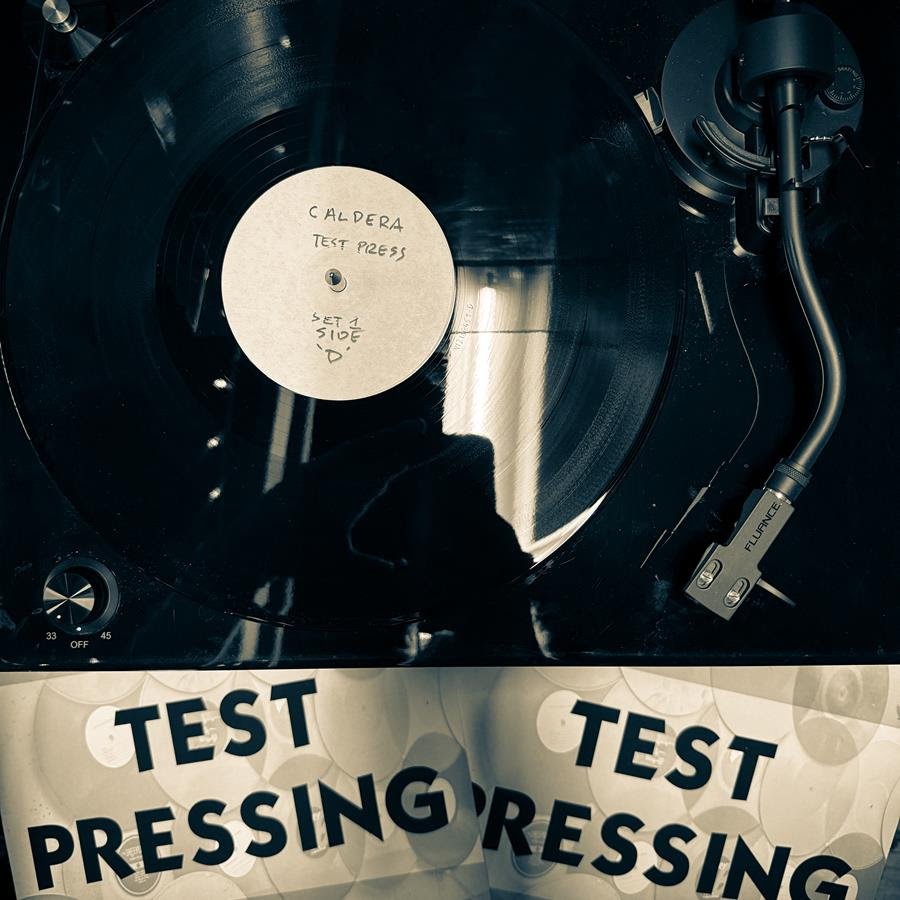
I gave the sonic landscape of Caldera its’ best chances to survive modern listening no matter what format it comes from, but I can tell you this: I just listened to the vinyl test pressing and every note, gesture, conscious decision and wild prayer we made in the last few years came floating through the air to me in the most satisfying way, and once in a while I’d glance in direction of the spinning black disc and feel like I had ‘arrived’.
Gregory Hoskins